Fashion eCommerce: 5 Key Elements to Maximise Black Friday
Contents
- Fashion's Average Discount: -24%
- Discounts and Strategy: The Impact of Black Friday in 2023
- Black Week vs Black Friday: Why Extend the Promotions
- Pre-Black Friday Communication: Newsletter and WhatsApp
- Post-Black Friday Results Analysis and Retention Strategy
- 5 Key Elements to Maximise Sales
Introduction: Fashion's Average Discount is -24%
Evolution of Historical Data
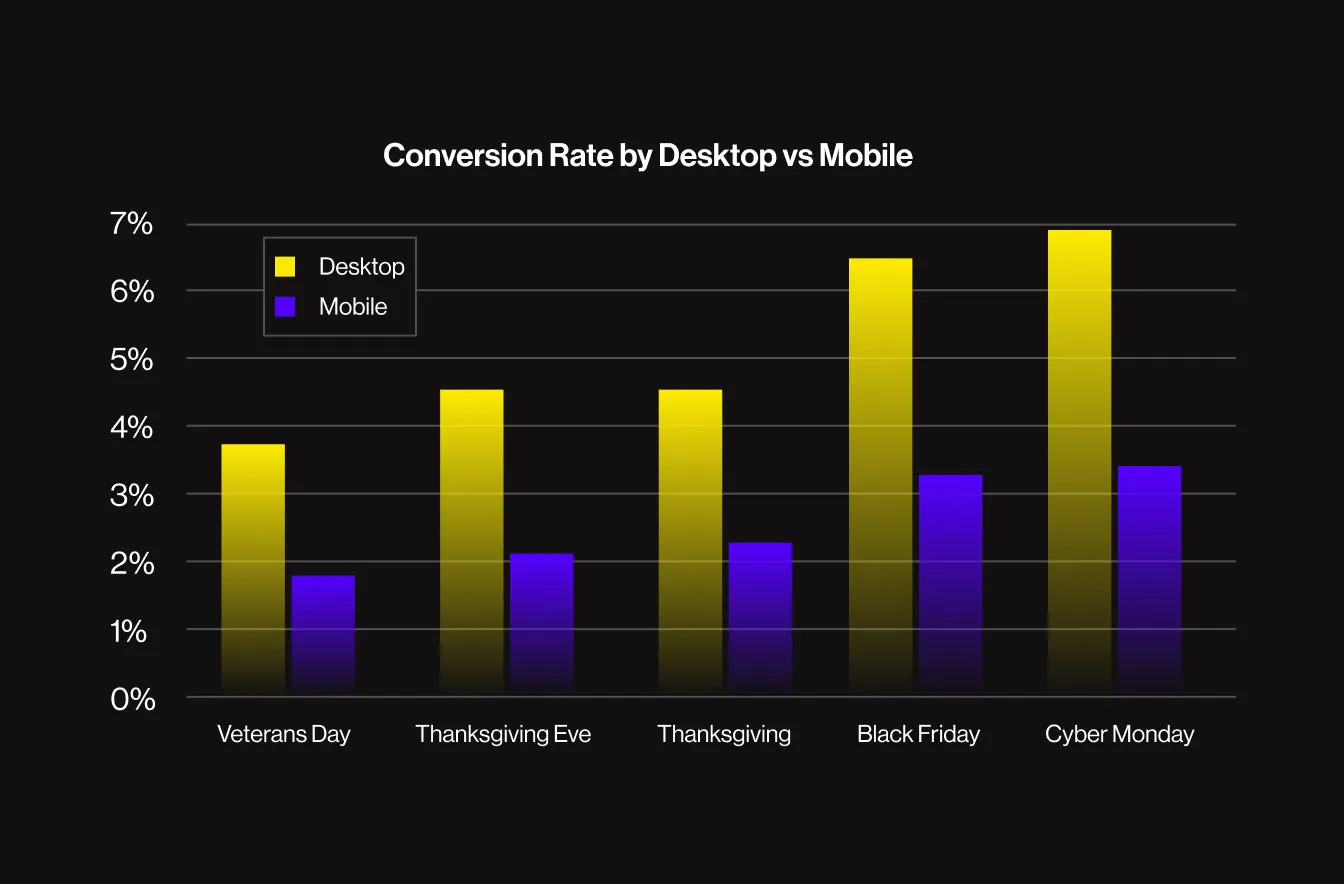
Black Friday has evolved considerably in recent years, establishing itself as a key event for fashion eCommerce, thanks to consumers' growing familiarity with online shopping. In 2023, Adobe Analytics data pointed to record sales, with $9.8 billion spent online in the US alone, up 7.5% on the previous year. This peak was driven by a wider range of promotions and the influence of social media, with engagement holding steady at around 34%, confirming its strategic relevance.
Statistical References
According to forecasts for 2024, the growth trend continues, with an estimated $240.8 billion in total sales over the holiday period, including Black Friday week. This progression reflects the adaptation of sales strategies, with moderate but effective discounts (24% for apparel) that keep margins high without excessive price concessions. We'll include charts showing sales trends by sector and the impact of discounting, illustrating how fashion eCommerce stores can make the most of the event without devaluing their products.
Sources:
Discounts and Strategy: The Impact of Black Friday in 2023
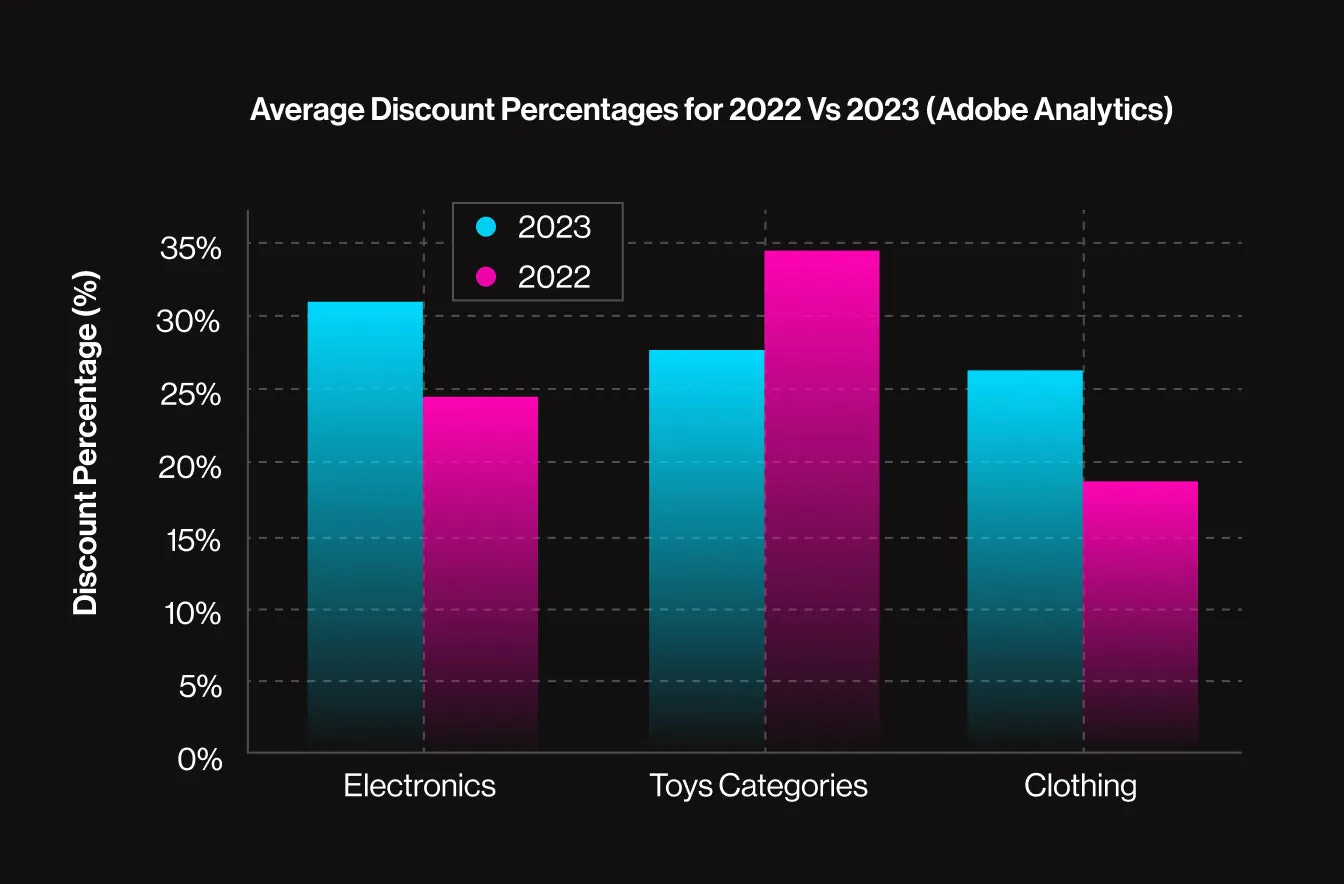
Average Discount Trends on Black Friday: Analysis of Adobe Analytics Statistics 2022-2023.
During Black Friday, the fashion and eCommerce sector saw steady growth in average discounts, adapting to consumer trends and competition. According to Adobe Analytics, in 2023 average discounts reached new record levels, with a significant impact on several product categories.
Key data:
- Electronics: In 2023, discounts reached 31%, up from 25% in 2022. The increase in this category's discounts shows retailers becoming more aggressive to attract consumers.
- Toys: Discounts fell from 34% in 2022 to 28% in 2023, suggesting retailers are optimising margins and reducing the need for steep discounts.
- Apparel: Discounts saw a significant increase, rising from 19% in 2022 to 24% in 2023, a sign of fashion's growing importance during Black Friday.
This data shows that, despite different strategies in each category, Black Friday remains a fundamental event for online sales, with a growing impact on the fashion sector. Companies are progressively calibrating discounts to balance sales and margins.
Black Week vs Black Friday: Why Extend the Promotions
When deciding between a single day of promotion (“Black Friday”) and a full week of discounts (“Black Week”), one of the key factors to consider is the time needed for advertising and promotional campaigns to reach their maximum impact.
According to a Deloitte study, 80% of consumers plan to shop during Black Friday-Cyber Monday week, and most of their shopping budget will be spent during this period. However, extended promotions, such as “Black Week”, are often more effective at boosting overall revenue. This is because advertising campaigns need a longer period to reach a wide audience and build a cumulative effect on sales. Data shows that digital marketing campaigns tend to deliver a better return when they have enough time to build consumer awareness and engagement.
Shorter promotions limited to a single day, like traditional Black Friday, can create a strong sense of urgency and exclusivity, but risk not making the most of advertising campaigns that need time to optimise results. In fact, one study finds that around 41% of consumers start shopping as early as October, taking advantage of early promotions. This shows that giving promotions more time can capture a wider slice of customers.
To better visualise the impact of different promotional durations on revenue, we'll create a chart showing how extending the promotion to a full week can lead to higher takings than a single Black Friday day.
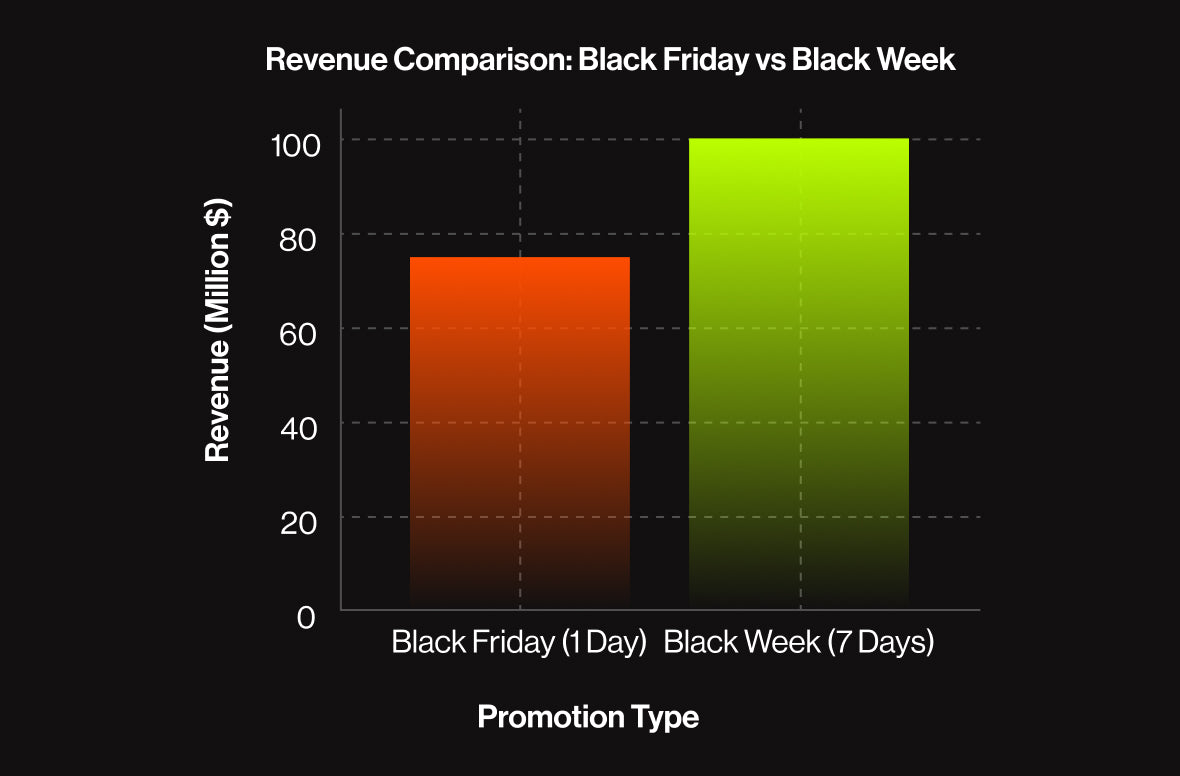
The chart above clearly shows how extending promotions to a Black Week (7 days) can lead to significantly higher takings than a single day of promotion (Black Friday). This is mainly due to the time advertising campaigns need to reach and engage a sufficient number of consumers, and the fact that longer promotions increase the likelihood that consumers will act on the offers.
Promotions spread over several days give campaigns enough time to mature, allowing for continuous optimisation of digital marketing strategies. What's more, the sense of urgency perceived by consumers can be maintained through targeted strategies such as daily “flash” offers, without having to limit everything to a single day.
Sources:
Pre-Black Friday Communication
Email Marketing Strategies
Email marketing remains one of the most powerful tools for pre-Black Friday communication. Building an effective newsletter sequence can make all the difference, especially when leveraging targeted segments and automations. According to Klaviyo, traditional email campaigns register an average open rate of 25% and a conversion rate of 0.07%, while automated emails such as abandoned cart flows achieve a much higher conversion rate, up to 2.4%.
Email campaigns need to focus on clear, urgent messaging, with personalised subject lines and highly visible CTAs. During Black Friday, email sequences that include early promotions and last-minute offers work particularly well, keeping users' attention high throughout the entire promotional period.
Using WhatsApp and SMS Marketing
Instant messaging platforms like WhatsApp and SMS are gaining increasing relevance. Recent Omnisend studies show that SMS campaigns during Black Friday achieved conversion rates of 0.45%, more than 2.5 times higher than promotional emails. Thanks to its more direct and personal nature, this channel helps create a greater sense of urgency and a more intimate communication with customers, especially when combined with email.
Klaviyo and Omnisend recommend integrating SMS and WhatsApp into the Black Friday communication flow to boost open and conversion rates, as consumers tend to pay more attention to these channels, especially during major promotional events.
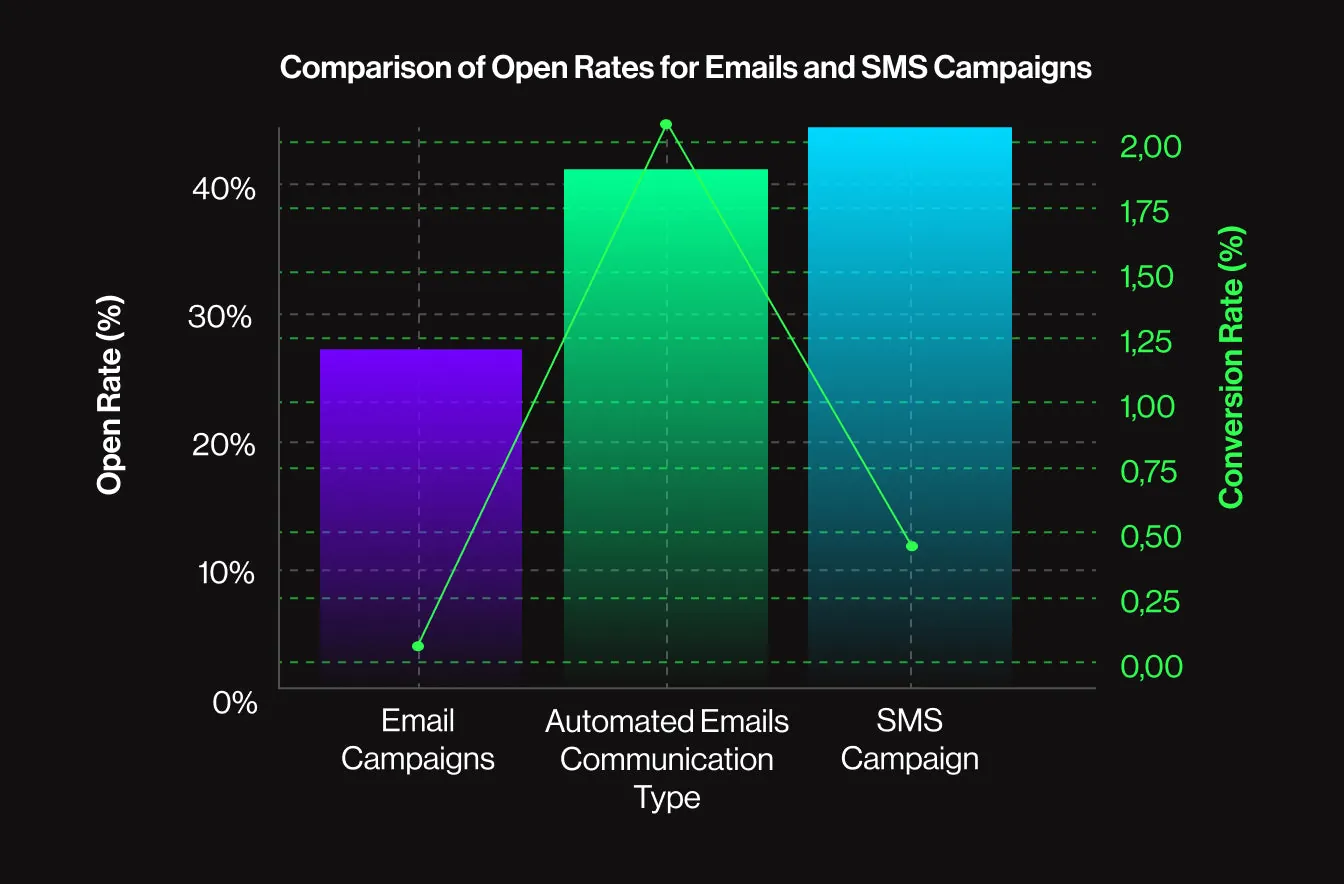
Here's the professional chart comparing open rates and conversion rates for email campaigns, automated emails and SMS campaigns. The chart shows how automated emails achieve much higher open and conversion rates than standard campaigns, while SMS campaigns show a significantly higher conversion rate, albeit with a slightly lower open rate.
This kind of visualisation can help you better understand the effectiveness of each communication channel during Black Friday.

Post-Black Friday Results Analysis and Retention Strategy
Evaluating Success: How to Analyse Black Friday Data
A proper analysis of post-Black Friday data is essential to understand how successful your campaigns were and to improve future strategies. Here are some key metrics you should consider:
- Return on Ad Spend (ROAS): Measures the return relative to your advertising budget. A ROAS above 4x is considered excellent in eCommerce.
- Conversion Rate: Looks at how many site visitors actually completed a purchase. Successful Black Friday campaigns should show a significant increase compared to the yearly average.
- Average Order Value (AOV): Checks whether discount campaigns increased the average value of each order.
- Customer Lifetime Value (CLV): Tracks the long-term value generated by customers acquired during Black Friday, taking into account their subsequent purchasing behaviour.
Track the long-term value generated by customers acquired during Black Friday, taking into account their subsequent purchasing behaviour. This highlights the importance of a solid follow-up and loyalty strategy.
Loyalty and Follow-up: Keeping Customers Engaged
Black Friday isn't just about short-term sales. Real success lies in turning occasional buyers into loyal customers. A Harvard Business Review study showed that acquiring new customers can cost up to 5 times more than retaining existing ones. What's more, loyal customers spend on average 67% more than new customers over the long term.
Retention Strategies:
- Loyalty Programmes: Offer exclusive discounts, loyalty points or priority access to events to encourage customers to come back.
- Follow-up Emails and SMS: After Black Friday, send a series of personalised emails to thank customers and offer discounts for future occasions. Post-purchase thank-you emails can improve the retention rate by up to 12%.
- Personalised Shopping Experience: Use the data collected during Black Friday to offer tailored promotions based on customers' behaviour and interests.
Sources:
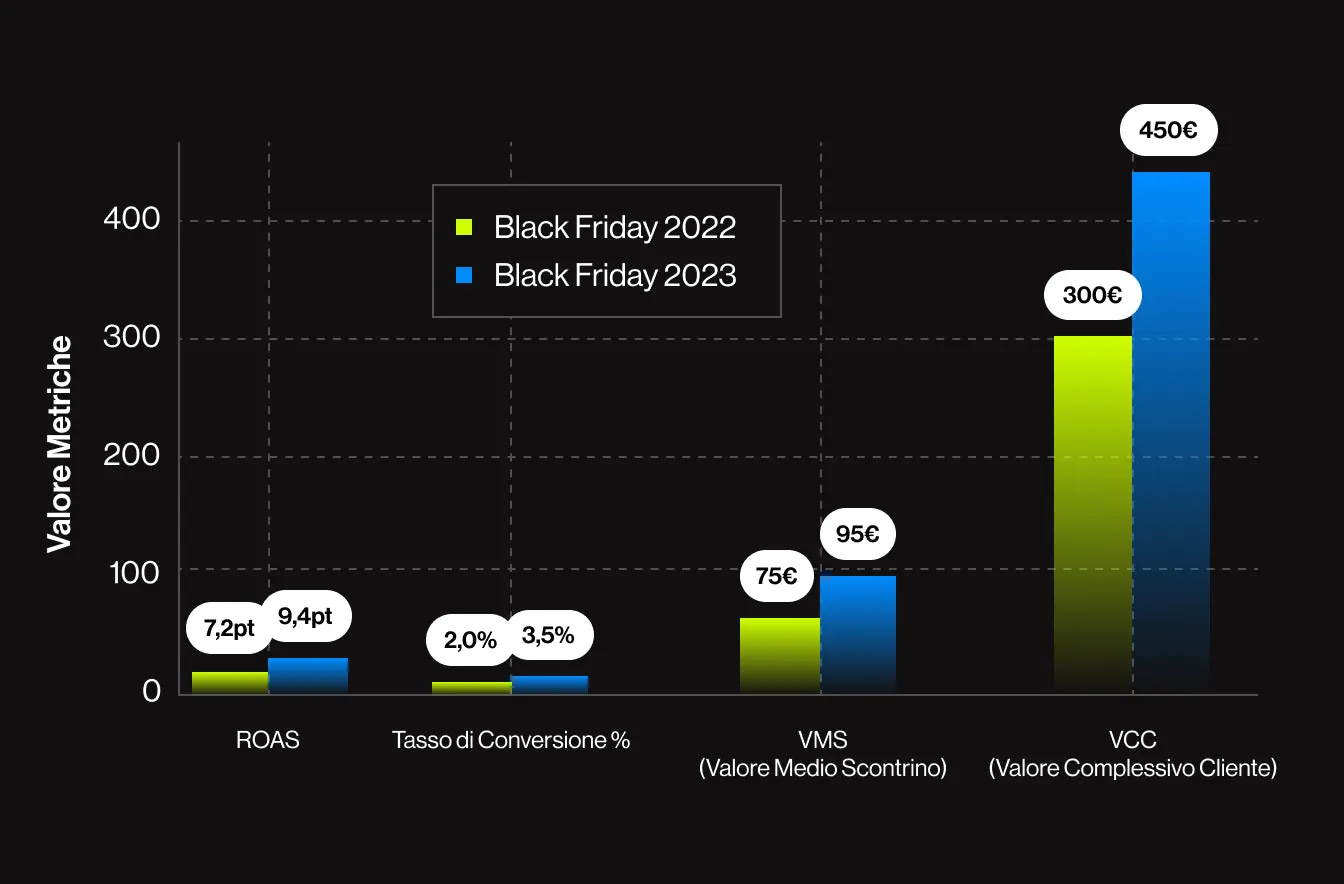
Post-Black Friday Metrics Analysis: Multibrand Client
The marketing and retention strategies implemented during Black Friday 2022 contributed significantly to the positive results seen in 2023. Thanks to these actions, 36% of customers acquired in 2022 returned to buy again in 2023, further improving the overall performance of the latest campaign. This shows the importance of a retention-focused strategy for boosting long-term results.
Explanation of the Metrics
- ROAS: The marketing and retention strategies implemented during Black Friday 2022 contributed significantly to the positive results seen in 2023. Thanks to these actions, 36% of customers acquired in 2022 returned to buy again in 2023, further improving the overall performance of the latest campaign. This shows the importance of a retention-focused strategy for boosting long-term results.
- Conversion Rate: The percentage of visitors who completed a purchase, useful for understanding how well the promotional action converted traffic into sales.
- AOV (Average Order Value): The average value of each transaction made during Black Friday, an indicator of customers' spending potential.
- CLV (Customer Lifetime Value): Measures the value generated by a customer over the entire relationship with the company, an important metric for assessing the long-term impact of customers acquired during Black Friday.
5 Key Elements to Maximise Success
From our experience as an agency, a successful Black Friday strategy in the fashion sector involves a few key elements:
- Minimum Discount of 20%: This discount level has proven effective at driving sales without excessively squeezing margins.
- Preferential Channel for Loyal Customers: Give regular customers early access to the promotion, with a dedicated exclusive shopping day. This prevents stock and size shortages and encourages loyalty.
- Communicating a Sense of Urgency: Use a sequence of emails and messages emphasising the final days or even the final hours of the promotion. Communicating urgency is essential to drive purchases.
- Promotion Lasting At Least 5 Days: Extending the promotion for at least five days allows advertising campaigns to move through their learning phase and reach optimal performance.
- Aggressive Strategy with Cyber Monday: For those aiming for a more aggressive strategy, Cyber Monday can be the last day of discounts, maximising buyer interest and closing the campaign with a final push in conversions.